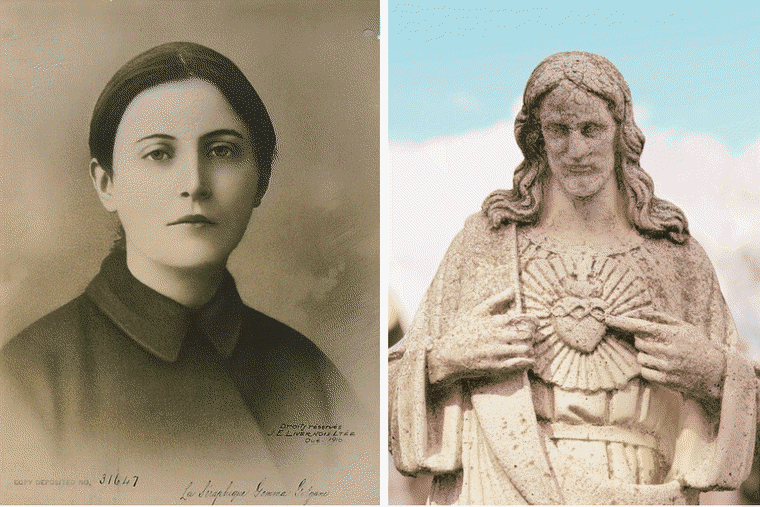
Una fotografía de Santa Gemma Galgani, publicada en 1916 junto a una estatua del Sagrado Corazón de Jesús.
(foto: Wikimedia Commons/Maria Ratta / Dominio público/Shutterstock)
..Textos.....Artículos ...INDEX
Visitaciones del Sagrado Corazón a Santa Gemma Galgani
Gemma tuvo mucho que reflexionar y decir sobre el Sagrado Corazón, junto con algunos de sus amigos santos.
Una fotografía de Santa Gemma Galgani, publicada en 1916 junto a
una estatua del Sagrado Corazón de Jesús.
(foto: Wikimedia Commons/Maria Ratta / Dominio público/Shutterstock)
Joseph Pronechen, National Catholic Register, 7 de junio de 2024
Joseph Pronechen es redactor de National Catholic Register desde 2005 y anteriormente fue corresponsal habitual del periódico. Sus artículos han aparecido en varias publicaciones nacionales, incluidas la revista Columbia, Soul, Faith and Family, Catholic Digest, Catholic Exchange y Marian Helper. Sus artículos religiosos también han aparecido en la revista católica del condado de Fairfield y en los principales periódicos. Es autor de Frutos de Fátima: siglo de señales y maravillas. Tiene un título de posgrado y anteriormente enseñó inglés y cursos de estudio cinematográfico que desarrolló en una escuela secundaria católica en Connecticut. José y su esposa María residen en la costa este.
Junio, el Mes del Sagrado Corazón de Jesús, enfatiza la importancia de la devoción al Sagrado Corazón. Santa Margarita María Alacoque, la “Apóstol de la Devoción al Sagrado Corazón de Jesús”, fue la primera en propugnar esta devoción. Nuestro Señor se le apareció el 27 de diciembre de 1673. La curó de graves enfermedades, se aparecía y hablaba frecuentemente con ella y le encomendó la misión de establecer la devoción a su Sagrado Corazón. El Señor le dijo que el amor de su Corazón debe extenderse a la gente.
Pero pocos saben que a finales del siglo XIX, Santa Gemma Galgani también tuvo una fuerte conexión con el Sagrado Corazón de Jesús. Ella también fue curada de graves dolencias físicas que la mantenían postrada en cama (y ni siquiera le daban esperanzas de sobrevivir), hasta que Jesús la curó.
Nacida en marzo de 1878, Gemma parecía dotada espiritualmente desde una edad temprana. Su tía Elisa Galgani describió cómo su sobrina “tenía un profundo amor por la Santísima Virgen y oraba a Ella con gran fervor y devoción, repitiendo a menudo: 'Santa María, hazme santa'. Tenía también una devoción muy especial al Sagrado Corazón de Jesús, a quien amaba ardientemente y a quien rezaba con extraordinario fervor” y llevaba consigo “pequeños cuadros de los Sagrados Corazones de Jesús y de María”.
Luego llegó el 17 de junio de 1887, la Solemnidad del Sagrado Corazón. Como Gemma estaba siendo atendida en otro lugar y no en casa, le escribió a su padre:
“Querido papá: Ha llegado la vigilia del día de mi primera Comunión, un día de felicidad ilimitada para mí. Te escribo para asegurarte mi afecto y pedirte que reces a Jesús por mí, para que cuando venga a mí por primera vez, me encuentre bien dispuesta a recibir todas las gracias que tiene preparadas para mí”.
Esas gracias llegarían a ser inconmensurables.
Avance rápido hasta 1901. Gemma le escribió a su director espiritual, el Venerable Padre Germanus Ruoppolo, un sacerdote pasionista, sobre ese día de junio más de una década anterior, como si acabara de suceder en ese momento:
“No sé, Padre, si habrá oído que la Solemnidad del Sagrado Corazón es efectivamente mi día de Solemnidad. Ayer, Padre, fue un día celestial; Estuve con Jesús todo el tiempo, fui feliz con Jesús, lloré con Jesús. Un recogimiento interior me mantuvo más unida que de costumbre a mi querido Jesús, pero mi alegría fue aún mayor, cuando por la tarde Jesús me bendijo. Le oí decir estas palabras: '¡Querida hija, hoy estoy complacido contigo!' Respondí: 'Oh Jesús, ojalá pudiera agradarte siempre'. Y lloré en lo más profundo de mi corazón: 'Oh pensamiento escalofriante del mundo, aléjate de mí; Quiero estar siempre con Jesús, y sólo con Jesús.' … Cuanto más pienso, más me doy cuenta de que sólo puedo ser feliz apoyándome en Tu Infinita Misericordia. ¡Oh Jesús misericordioso!'”
Ella continuó:
“Padre [Germanus], ¿hacia dónde me han llevado mis pensamientos? A ese hermoso día de mi primera Comunión. Ayer, solemnidad del Sagrado Corazón, experimenté una vez más la alegría de aquel día feliz. Ayer probé nuevamente los placeres del Paraíso. Pero ¿qué es el disfrute de un día comparado con los siglos de la eternidad? Puedo decir con verdad que ese día de mi primera Comunión mi corazón estaba más ardiendo de amor por Jesús. Qué feliz fui cuando con Jesús en mi corazón pude decir: 'Oh Dios mío, tu Corazón es como el mío; Lo que a Ti te complace, también puede hacerme feliz. ¿Qué necesito entonces? Nada. Si comparo la paz del corazón que tenía el día de mi primera Comunión con la que experimento ahora no encuentro diferencia...'”
No fue una sorpresa que la Solemnidad del Sagrado Corazón se convirtiera en el día de devoción distintivo de Gemma Galgani. Cada año, en la fiesta, se unía en espíritu a todos los primeros comulgantes.
Los futuros santos se 'encuentran'
Retrocedamos dos años hasta 1899, cuando dos santos del Sagrado Corazón “se encontraron”. En la solemnidad de la Inmaculada Concepción anterior de 1898, Gemma se convirtió en Hermana Barbantina. Pero en febrero padecía intensamente varios problemas de columna, además de un tumor añadido que le causaba “violentos dolores espasmódicos”. Los médicos dijeron que ella moriría.
Luego, el 19 de febrero, Mons. Juan Volpi, obispo de Arezzo, que conocía bien a Gemma, le pidió que hiciera una novena a la entonces beata Margarita María Alacoque.
“Gemma no estaba entusiasmada. Habría anhelado curarse si su alma no hubiera estado tan llena de deseo de unión con Dios”, según su biógrafo, el padre Amadeo, pasionista . Pero obedeció a su confesor y comenzó la novena, mas al día siguiente se le olvidó. De nuevo empezó, y otra vez lo olvidó.
Comenzó por tercera vez antes de la medianoche del 23 de febrero. Contó la visión celestial que tuvo entonces:
“Escuché el sonido de un Rosario y sentí una mano puesta en mi frente. Entonces una voz comenzó a decir el Padre Nuestro, Ave María y Gloria al Padre, nueve veces. Apenas sabía qué decir, estaba tan débil por el dolor. La misma voz que había dicho el Padre Nuestro, me preguntó:
—'¿Quieres curarte?'
—"A mí me da lo mismo", respondí.
—'Sí', continuó, 'te curarás. Ora con fe al Sagrado Corazón de Jesús. Todas las tardes, hasta el final de la novena, vendré y rezaremos juntos al Sagrado Corazón.'
—¿Y qué pasa con la beata Margarita María?, pregunté yo.
—'Añade el Gloria al Padre tres veces en su honor'”.
La voz, según supo, era la de Gabriel de Possenti, aún no canonizado. Había muerto en 1862 y fue conocido como San Gabriel de la Dolorosa.
"Gemma, ¿qué estás haciendo?", dijo él. “Has comenzado la Novena a la Beata Margarita para obtener el favor y lo has vuelto a olvidar; ¿Te parece que esta es la manera de pedir favores? ... Oh Gemma, la bienaventurada Margarita está tan afligida por tu causa; ella te ama, quisiera obtenerte tantos favores, quisiera curarte, hacerte toda suya, pero no puede: el Corazón de Jesús la frena porque oras muy poco y sin devoción".
Gabriel inició con ella la Novena al Sagrado Corazón de Jesús, rezando “nueve Paters, Avemarías y Glorias.
"...Y para que no la olvides, la haremos juntos durante nueve tardes a esta misma hora. Al terminar la del Sagrado Corazón de Jesús, harás otra a la Beata Margarita, y recitarás nueve Glorias. ¿Hacemos esto de inmediato?
Su visitante celestial llegaba todas las noches, ponía su mano sobre ella y juntos recitaban el Padre Nuestro al Sagrado Corazón y luego añadían el Gloria al Padre en honor de la Beata Margarita María.
“La novena debía terminar el primer viernes de marzo”, refire Gemma.
A la mañana siguiente recibió la Sagrada Comunión. Jesús le dijo:
“Gemma, ¿quieres curarte?”
Gemma recordó, embargada por la emoción, que
“no podía hablar… ¡Pobre Jesús! La gracia fue concedida". Me curé. … Esa mañana lloré con Jesús.
Y Jesús, siempre bueno, siempre tierno, decía:
"Siempre estaré contigo, hija mía. Yo soy tu padre”, y señalando a María, Madre de los Dolores, “ella será tu madre”. La ayuda de un padre nunca le faltará a quien se ponga en Mis manos. Aunque te he quitado todo apoyo y consuelo en la tierra, nada te faltará jamás'”.
Jesús también dijo:
“¿No estás feliz de ser hija de Jesús y María?”
Y Gemma reflexionaba :
“El gran afecto que Jesús tenía escondido en su Corazón por mí me dejó sin palabras”.
De hecho, fue curada ese primer viernes, día dedicado al Sagrado Corazón de Jesús.
Al final de esa novena, San Gabriel también le dijo:
“Oh, qué feliz está Jesús por la hermosa promesa que le has hecho de hacer la Hora Santa todos los jueves. Nunca lo olvides. Y la Beata Margarita también está feliz; ella ha conseguido del Corazón de Jesús el permiso para curarte, y debes hacerle una justa promesa... piensa a menudo en la bienaventurada Margarita, porque ella te ama y te dará muchas gracias”.
Gemma preguntó por qué la Beata Margarita María la amaba cuando Gemma nunca pensó en ella ni le oró.
Gabriel respondió :
“Porque eres una pobre alma que ella desea llevar a Jesús”.
Gemma decía que no conocía otras palabras para decir aparte de
“¡Jesús, te lo agradezco! ... ¡Bendita Margarita, gracias!”
Éxtasis, Visiones, Estigmas
El 8 de junio de 1899, vigilia de la Solemnidad del Sagrado Corazón, después de la Sagrada Comunión, Gemma escuchó a Jesús decirle a su corazón :
“¡Gemma, coraje! Te espero en el Calvario hacia donde va tu nave”.
Esa noche se le apareció la Santísima Madre y el ángel de la guarda de Gemma.
María le dijo:
“Jesús mi Hijo te ama mucho y desea hacerte un favor. ¿No puedes hacerte digna de ello? Seré una Madre para ti; ¿Te mostrarás como una verdadera hija mía?
Y cubrió a Gemma con su manto.
Gemma cuenta que, a continuación,
“Jesús apareció con todas sus llagas abiertas, pero en lugar de sangre, de ellas salían llamas como de fuego. En un instante esas llamas tocaron mis manos, pies y corazón”.
Ella recibió los estigmas.
Sus heridas sangraron hasta el día siguiente, las tres de la tarde de la Solemnidad del Sagrado Corazón. Ese mismo Mes del Sagrado Corazón, después de su habitual Hora Santa, Jesús le reveló todo lo que le tocaría sufrir el resto de su vida.
Reflexiones sobre el Sagrado Corazón
Gemma fue favorecida con muchos éxtasis y visiones de Jesús sufriendo con la cruz sobre sus hombros, o de Jesús señalando su Sagrado Corazón. A veces también aparecía como un hermoso niño. También la visitaron la Santísima Virgen, su ángel de la guarda y San Gabriel de la Dolorosa.
En su libro, el padre Amadeo señaló que Jesús le mostró su corazón, como lo había hecho con santa Margarita María.
Gemma dijo:
“¿Abres ahora Tu Corazón para mí? ¡Oh, si tan solo todos los pecadores vinieran a Tu Corazón! ¡Venid, pecadores, no temáis! Allí la espada de la Justicia no os alcanzará. … ¡Oh, qué hermoso es Tu Corazón! ... Oh Jesús, deseo que mi voz sea escuchada en todo el mundo. Insto a todos los pecadores a buscar refugio en Tu Corazón”.
Para Gemma, había una conexión inquebrantable entre el Sagrado Corazón y la Sagrada Comunión, una conexión tan actual como el avivamiento Eucarístico de hoy y un reflejo de los hallazgos científicos de los milagros eucarísticos de las Hostias: tejido del corazón.
Le dijo a su director espiritual:
“Padre, déjeme hablarle de la Sagrada Comunión... ¿Hay almas que no entienden qué es realmente la Eucaristía? ¿Será posible que haya almas insensibles a los impulsos divinos, a las misteriosas efusiones ardientes del Sagrado Corazón de Jesús? ¡Oh Corazón de Jesús, cómo puede el hombre negarse a consagrarte todos los latidos de su corazón, toda la sangre de sus venas! ¡Oh Corazón de Jesús, Corazón de Amor!”
Animó:
“¡Qué alegría se experimenta cuando se abandona en los brazos de Jesús! El alma fiel se convierte en su hijo más querido. Abre sus brazos para recibirlo y lo estrecha contra su Sagrado Corazón”.
Santa Gemma Galgani murió en 1903. Fue canonizada en 1940, pero, curiosamente, su causa fue aprobada oficialmente por el Papa en 1920, el mismo año en que fueron canonizados San Gabriel y Santa Margarita María Alacoque.
---------------------
St. Gemma Galgani’s Visions and Visits of the Sacred Heart
Gemma had much to reflect on and say about the Sacred Heart — along with some of her holy friends.
A photo of St. Gemma Galgani, published in 1916 alongside a
statue of the Sacred of Heart of Jesus.
(photo: Wikimedia Commons/Maria Ratta / Public Domain/Shutterstock)
Joseph Pronechen, National Catholic Register, June 7, 2024
Joseph Pronechen is staff writer with the National Catholic Register since 2005 and before that a regular correspondent for the paper. His articles have appeared in a number of national publications including Columbia magazine, Soul, Faith and Family, Catholic Digest, Catholic Exchange, and Marian Helper. His religion features have also appeared in Fairfield County Catholic and in major newspapers. He is the author of Fruits of Fatima — Century of Signs and Wonders. He holds a graduate degree and formerly taught English and courses in film study that he developed at a Catholic high school in Connecticut. Joseph and his wife Mary reside on the East Coast.
June, the Month of the Sacred Heart of Jesus, emphasizes importance to devotion to the Sacred Heart. St. Margaret Mary Alacoque, the “Apostle of the Devotion to the Sacred Heart of Jesus,” was the first to promulgate this devotion. Our Lord appeared to her on Dec. 27, 1673. He cured her of serious illnesses, would appear and talk to her frequently, and gave her the mission to establish the devotion to his Sacred Heart. The Lord told her that the love of his Heart must spread to people.
But few realize that in the late 19th century, St. Gemma Galgani also had a strong connection to the Sacred Heart of Jesus. She, too, was cured of serious physical ailments that kept her bedridden (and even gave her no hope to survive) — until Jesus cured her.
Born in March 1878, Gemma appeared spiritually gifted at a young age. Her aunt Elisa Galgani described how her niece “had a deep love for the Blessed Virgin and prayed to Her with great fervor and devotion, often repeating: ‘Holy Mary, make me a saint.’ She had also a very special devotion to the Sacred Heart of Jesus whom she ardently loved and to whom she prayed with extraordinary fervor” and carried with her “little pictures of the Sacred Hearts of Jesus and Mary.”
Then came June 17, 1887, the Solemnity of the Sacred Heart. Because Gemma was being taken care of elsewhere and not at home, she wrote to her father, “Dear Papa, The vigil of my first Holy Communion day has come, a day of unbounded happiness for me. I am writing to assure you of my affection, and to ask you to pray to Jesus for me that when He comes to me for the first time, He may find me well disposed to receive all the graces He has prepared for me.” Those graces were to become immeasurable.
Fast-forward to 1901: Gemma wrote to her spiritual director, Venerable Father Germanus Ruoppolo, a Passionist priest, of that June day over a decade earlier as if it had just happened presently.
“I do not know, Father, whether you have heard that the Solemnity of the Sacred Heart is indeed my Solemnity day. Yesterday, Father, was a heavenly day; I was with Jesus all the time, I was happy with Jesus, I wept with Jesus. An interior recollection kept me more than usually united to my dear Jesus, but my happiness was even greater, when in the evening Jesus blessed me. I heard Him say these words: ‘Dearest daughter, I am pleased with you to-day!’ I answered: ‘0 Jesus, would that I could please Thee always.’ And I cried in the depths of my heart: ‘Oh chilling thoughts of the world, go far from me; I want to be always with Jesus, and with Jesus alone.’ … The more I think, the more I realize that I can be happy only by casting myself upon Thine Infinite Mercy. 0 Jesus most merciful!’”
She continued,
“Father [Germanus], where have my thoughts carried me to? To that beautiful day of my first Communion. Yesterday, the Solemnity of the Sacred Heart, I experienced once again the joy of that happy day. Yesterday, I again tasted the pleasures of Paradise. But what is the enjoyment of a day compared with the ages of eternity? I can say with truth that on that day of my first Communion my heart was most on fire with love for Jesus. How happy I was when with Jesus in my heart I could say: ‘Oh my God, Thy Heart is like mine; what gives Thee pleasure, can make me happy also. What then am I in need of? Nothing. If I compare the peace of heart that was mine on the day of my first Communion with that which I experience now I find no difference ...’”
It was no surprise that the Solemnity of the Sacred Heart became Gemma Galgani’s own distinctive day of devotion. Yearly, on the feast, she would unite herself with all the first communicants in spirit.
Future Saints ‘Meet’
Rewind two years to 1899, when two saints of the Sacred Heart “met.” The prior 1898 Solemnity of the Immaculate Conception saw Gemma becoming a Barbantine Sister. But by February she was in intense suffering from several spinal problems, plus an added tumor causing “violent spasmodic pains.” Doctors said she would die.
Then, on Feb. 19, Msgr. John Volpi, bishop of Arezzo, who knew Gemma well, told her to make a novena to then-Blessed Margaret Mary Alacoque.
“Gemma was not enthusiastic. She would have longed to be cured had not her soul been so filled with desire for union with God,” according to her biographer, Passionist Father Amedeo.
But she obeyed her confessor and started the novena, but the following day, she forgot. Again, she began, and again forgot.
She began a third time before midnight on Feb. 23.
She would tell of the heavenly vision she had then:
“I heard the sound of a Rosary and I felt a hand placed on my forehead. A voice then began to say the Our Father, Hail Mary and Glory Be to the Father, nine times. I hardly knew what to say I was so weak with pain.
The same voice that had said the Our Father, asked me:
—‘Do you wish to be cured?’
—‘It is all the same to me,’ I replied.
—‘Yes,’ he continued, ‘you will be cured. Pray with faith to the Sacred Heart of Jesus. Every evening until the end of the novena I shall come and we shall pray together to the Sacred Heart.’
—‘And what about Blessed Margaret Mary?’, I asked.
—‘Add the Glory Be to the Father three times in her honor.’”
The voice, she was to learn, was that of Gabriel of Possenti, not yet canonized. He had died in 1862 and b was known as (St.) Gabriel of the Sorrowful Mother.
“Gemma, what are you doing?” he said. “You have begun the Novena to the Blessed Margaret to obtain the favor and you have forgotten it again; does it seem to you that this is the way to ask for favors? ... Oh Gemma, the Blessed Margaret is so afflicted because of you; she loves you, she would like to obtain for you so many favors, she would like to cure you, to make you all hers, but she cannot: The Heart of Jesus restrains her because you pray so little, and with no devotion".
Gabriel began the Novena to the Most Sacred Heart of Jesus with her, praying “nine Paters, Aves, and Glories", and so that you will not forget it, we will do it together for nine evenings at this same hour. Having finished that to the Sacred Heart of Jesus, you will make one to the Blessed Margaret, and recite nine Glorias. Shall we do this at once?”
Her heavenly visitor arrived every evening, placed his hand on her, and, together, they recited the Our Father to the Sacred Heart, and then added the Glory Be to the Father in honor of Blessed Margaret Mary.
“The novena was to end on the first Friday of March,” Gemma would report.
That following morning, she received Holy Communion. Jesus said to her:
“Gemma, do you wish to be cured?’
Gemma recalled, being overcomes with emotion that she
“could not speak … Poor Jesus! The grace was granted; I was cured. … That morning I wept with Jesus, and Jesus, always good, always tender, was saying:
‘I shall always be with you, my daughter. I am thy father,’ and, pointing to Mary the Mother of Sorrows,’ she will be your mother. A father’s help will never be wanting to whoever puts himself in My hands. Although I have taken away from you every support and consolation on earth, nothing will ever be wanting to you.’”
Jesus also said, “Are you not happy to be the daughter of Jesus and Mary?”
And Gemma would reflect, “
"The great affection which Jesus had hidden in his Heart for me made me speechless.”
Indeed, she was cured that First Friday, a day devoted to the Sacred Heart of Jesus.
At the end of that novena, St. Gabriel also told her,
“Oh, how happy Jesus is about the lovely promise that you have given him of making the Holy Hour every Thursday. Never forget it. And the Blessed Margaret is also happy; she has secured from the Heart of Jesus permission to cure you, and you ought to make to her a fair promise … think often of the Blessed Margaret, because she loves you and will give you many graces.”
Gemma asked why Blessed Margaret Mary loved her, when Gemma never thought of her or prayed to her.
Gabriel answered,
“Because you are a poor little soul whom she wishes to bring to Jesus.”
Gemma would say that she knew no other words to say other than
“Jesus, I thank you!; ... Blessed Margaret, thank you!”
Ecstasy, Visions, Stigmata
On June 8, 1899, the vigil of the Solemnity of the Sacred Heart, after Holy Communion, Gemma heard Jesus say to her heart:
“Gemma, courage! I am waiting for the—e on Calvary towards which Your art journeying.”
That evening, the Blessed Mother and Gemma’s guardian angel appeared to her.
Mary told her:
“Jesus my Son loves thee much, and wishes to confer a favor on thee. Canst you render thyself worthy of it? I will be a Mother to thee; will You show thyself a true daughter of mine?”
. Gemma recounted that, next:
“Jesus appeared with all His wounds open, but instead of Blood, flames as it were of fire issued from them. In an instant those flames touched my hands, feet and heart”.
She received the stigmata.
Her wounds bled until next day, three o’clock in the afternoon of the Solemnity of the Sacred Heart. That same Month of the Sacred Heart, after her usual Holy Hour, Jesus revealed to her all she would have to suffer the rest of her life.
Reflections on the Sacred Heart
Gemma was favored with many ecstasies and visions of Jesus suffering from the cross on his shoulders, or Jesus pointing to his Sacred Heart. Sometimes he also appeared as a beautiful child. The Blessed Mother, her guardian angel and St. Gabriel of the Sorrowful Mother also visited her.
In his book Father Amedeo noted that Jesus showed his heart to her, as he had done to St. Margaret Mary.
Gemma said:
“[D]o You now open Thy Heart for me? Oh, if only all sinners would come to Thy Heart. Come, sinners, do not fear! The sword of Justice will not reach you there. … Oh, how beautiful is Thy Heart! ... O Jesus, I wish that my voice could be heard all over the world; I would urge all sinners to seek refuge in Thy Heart.”
For Gemma, there was an unbreakable connection between the Sacred Heart and Holy Communion, a connection as current as today’s Eucharistic Revival and a reflection of scientific findings of Hosts’ Eucharistic miracles — found to be heart tissue.
She told her spiritual director,
“Father, let me speak about Holy Communion ... Are there souls who do not understand what the Eucharist really is? Is it possible that there are souls insensible to the divine urgings, to the mysterious ardent effusions of the Sacred Heart of Jesus? O Heart of Jesus, how can mankind refuse to consecrate to Thee all the beats of their hearts, all the blood of their veins! Oh Heart of Jesus, Heart of Love!”
She encouraged:
“What joy one experiences when one abandons oneself into the arms of Jesus! The faithful soul becomes his dearest child. He opens his arms to receive it, and presses it to his most Sacred Heart.”
St. Gemma Galgani died in 1903. She was canonized in 1940, but, interestingly, her cause was officially approved by the Pope in 1920 — the same year St. Gabriel and St. Margaret Mary Alacoque were canonized.